
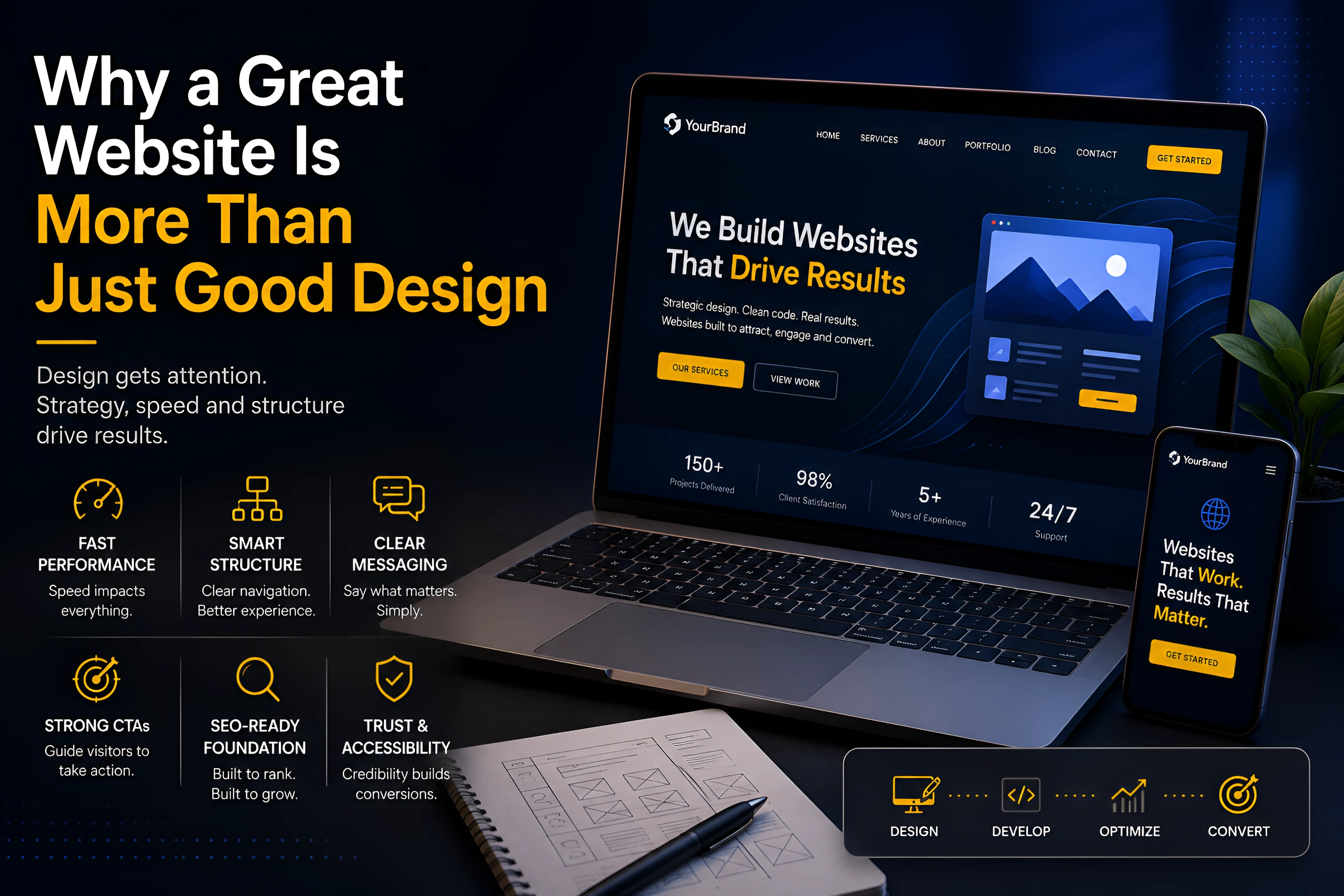
Most conversations about a website start with how it looks. That's understandable — visual design is the first thing anyone notices — but it's also where a lot of businesses stop thinking about the problem. A website can be genuinely attractive and still fail to do the one thing it exists to do: help the business.
Why Visual Design Alone Isn't Enough
Design and function are often treated as separate conversations, handled by different priorities at different stages of a project. In practice, they can't really be separated. A beautifully designed page that hides its contact form, loads slowly, or confuses a visitor about what to do next isn't succeeding as a design — it's failing at the actual job the page has to do.
Visual polish matters. It signals credibility and care. But it's a foundation for the website's real work, not the work itself.
First Impressions Happen in Seconds
A visitor typically decides whether to stay on a page within the first few seconds of arriving. In that window, they're not evaluating font choices — they're subconsciously asking whether this looks like a business they can trust, whether it seems relevant to what they were looking for, and whether it's going to be easy or frustrating to use.
That first impression is shaped by more than color and layout. Load time, how quickly the page's purpose becomes clear, and whether the design feels current all factor into that split-second judgment, often before a visitor consciously registers any of it.
User Experience Is the Real Product
User experience — how easily someone can find what they need, understand what's being offered, and take the next step — is arguably more important to a website's success than any individual visual choice. A visitor who can't find the pricing page, can't tell what the business actually does, or hits a broken link at a critical moment will leave, regardless of how polished the homepage looked.
Good UX is often invisible precisely because it works. Visitors don't notice a well-structured navigation menu; they only notice a confusing one.
Mobile Responsiveness Isn't Optional Anymore
For most businesses, a majority of website traffic now arrives on a phone, not a desktop. A site that was designed for desktop and then awkwardly compressed for mobile — rather than genuinely built to work on smaller screens from the start — creates friction exactly where the most visitors are showing up. Buttons that are too small to tap comfortably, text that requires zooming, or layouts that break on common screen sizes all quietly cost conversions that never get noticed, because the visitor simply leaves without complaint.
Website Speed Affects Everything Downstream
Speed isn't just a technical detail — it directly affects whether visitors stay long enough to see the rest of the design and messaging at all. A slow-loading page loses visitors before it has the chance to make its case, and that's true regardless of how much work went into what's on the page. Speed also plays a role in search visibility, since search engines factor loading performance into how pages are evaluated. Treating performance as a launch-week afterthought, rather than a requirement from the start, tends to show up later as a quiet, hard-to-diagnose drag on results.
Information Architecture: Can Visitors Actually Find What They Need
Information architecture — how a site's content and pages are organized — determines whether a visitor's journey feels obvious or like guesswork. A logical structure anticipates the questions a visitor actually has and makes the answers easy to reach: what does this business do, what does it cost, how does someone get started, and where can they go if they have questions. When that structure is unclear, even genuinely good content and design underneath it can go unseen.
Clear Messaging Beats Clever Messaging
It's tempting to reach for a clever headline or an abstract tagline, but a visitor who has to work to understand what a business actually offers is a visitor who is likely to leave before figuring it out. The most effective website messaging tends to be the most direct: what you do, who it's for, and why it matters — stated plainly, then supported with the detail and personality that makes a brand distinct.
Calls to Action Deserve as Much Thought as the Homepage
A website can generate real interest and still convert almost none of it if the next step isn't obvious. Every page should have a clear, singular idea of what a visitor should do next — not a scattering of competing buttons asking for different things. That might be a single contact form, a single primary offer, or a single clear next page to visit, deliberately placed where a genuinely interested visitor is ready to act.
A simple example: a service page that ends with three equally weighted buttons — "Learn More," "Contact Us," and "View Pricing" — asks a visitor to make a decision the business should have already made for them. A page that instead builds toward one clear next step, with secondary options available but visually de-emphasized, tends to convert more of the interest it generates, simply because it removes a decision the visitor didn't come there to make.
SEO Foundations Belong in Development, Not After Launch
A website's technical structure — semantic HTML, a sensible heading hierarchy, clean URLs, reasonable page speed — either supports search visibility or works against it, and that structure is far easier to build correctly from the start than to retrofit later. A site can be built on a genuinely SEO-ready foundation and still need an ongoing SEO strategy to actually rank — the foundation makes that strategy possible, not automatic. We go into what that ongoing work involves in Why SEO Still Matters in 2026.
Trust, Credibility and Accessibility
Visitors look for signals that a business is legitimate and worth their time — clear contact information, consistent and professional presentation, and content that reads as genuinely written for them rather than generic filler. A site that's vague about who runs it, hard to reach, or inconsistent in tone between pages quietly raises doubt, even if no single element is obviously wrong.
Accessibility is part of this same picture, not a separate checklist. A site that's difficult to navigate by keyboard, has poor color contrast, or ignores basic semantic structure isn't just excluding some visitors — it's signaling a lack of attention to detail that can undermine trust more broadly, while also closing the door on a meaningful share of potential customers who rely on assistive technology.
How a Website Should Support Business Goals
A website's design decisions should ultimately be judged against what the business actually needs the site to do — generate leads, support existing customers, explain a service clearly, or sell a product directly. A visually striking site that doesn't move its actual goal forward hasn't succeeded, even if it wins compliments. The most useful question at every stage of a website project isn't "does this look good" — it's "does this help someone become a customer."
How Xova Digital Approaches Web Design & Development
We treat a website as infrastructure for the rest of a business's marketing, not a one-time design project. That means starting with the audience and the business goal before any visual direction is chosen, building on a technically sound and SEO-ready foundation, and designing every page around a clear next step for the visitor. You can see the full detail of how we approach builds and redesigns on our Web Design & Development page.
Key Takeaways
- Visual design and website performance aren't separate conversations — a page that looks good but loads slowly or confuses visitors is failing at its actual job.
- Mobile experience and page speed directly affect whether visitors stay long enough to see anything else.
- Clear information architecture and direct messaging usually outperform cleverness.
- SEO foundations are far easier to build in from the start than to retrofit after launch.
- A website should ultimately be judged by whether it moves the business's actual goal forward, not just how it looks.
Frequently Asked Questions
Design matters, but it's one part of a larger picture that includes user experience, speed, mobile performance and clear messaging. A well-designed page that's slow or confusing still underperforms.
For most businesses, a majority of visitors now arrive on mobile devices, so a site that isn't genuinely built to work well on smaller screens is creating friction for the largest share of its traffic.
Often, yes. Targeted improvements to speed, structure, messaging or conversion paths can meaningfully improve performance without necessarily requiring a full rebuild — it depends on what's actually holding the site back.
No single element guarantees results. A well-built website removes friction and gives visitors a clear path to act, which meaningfully improves the odds — but it works alongside the marketing that brings visitors there in the first place.
Your Website Should Work as Hard as Your Marketing.
If your website needs to attract, engage and convert the right visitors, Xova Digital can help build a digital experience around your business goals.