
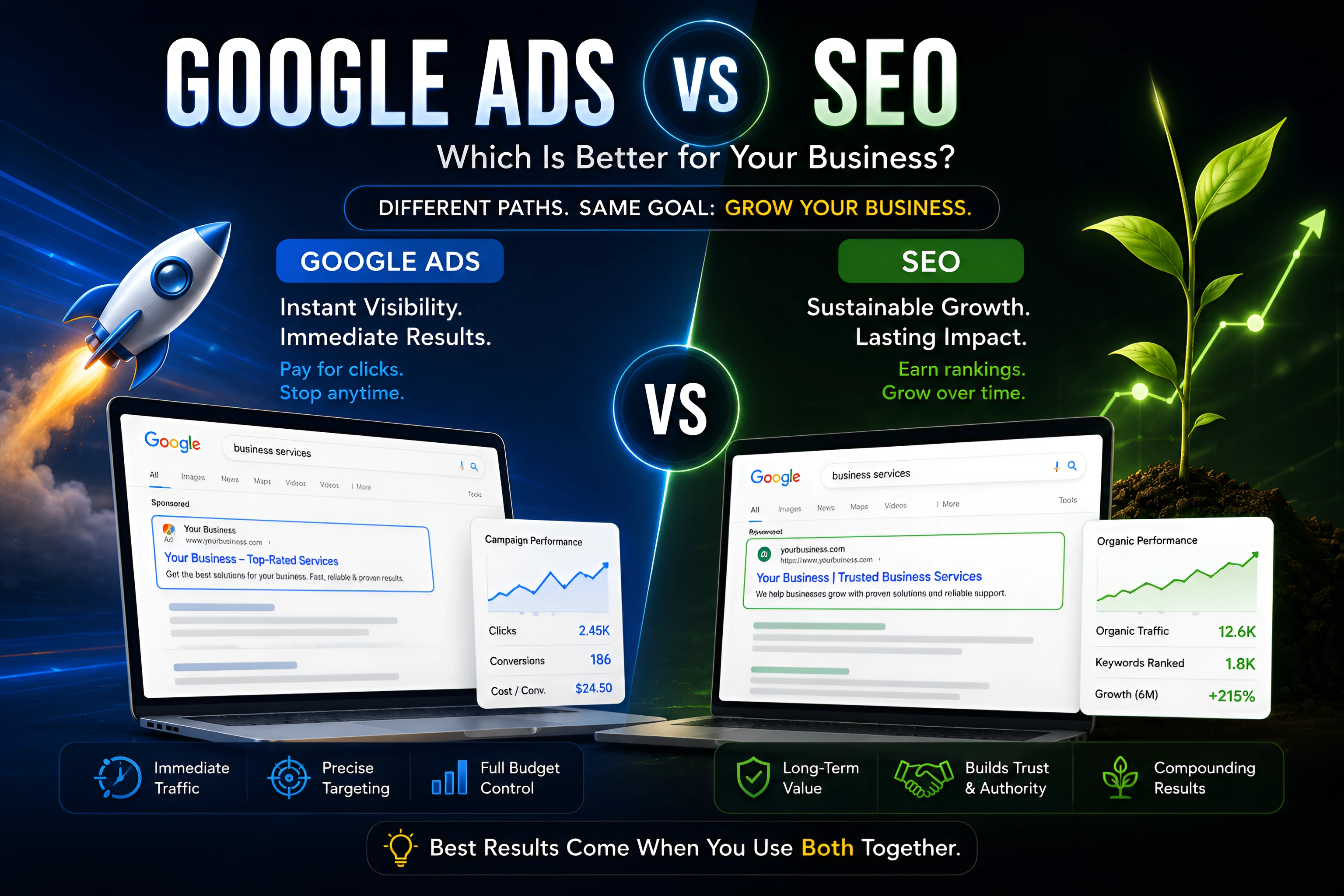
This is one of the most common questions a business asks when deciding where to put a marketing budget: should the money go toward Google Ads, toward SEO, or both? The honest answer depends on specifics that differ for every business — but understanding what each channel actually does makes that decision considerably easier.
What SEO Is
SEO is the practice of improving a website's technical health, content and authority so it ranks well in organic (unpaid) search results. It's a longer-term investment: visibility builds gradually and, once established, doesn't require ongoing spend to maintain. We go into this in more depth in Why SEO Still Matters in 2026.
What Google Ads Is
Google Ads is a paid platform that places a business at or near the top of search results — and across other Google properties — for keywords it bids on. Visibility is immediate and controllable: a business can choose exactly which searches to target, how much to spend, and can adjust or pause a campaign at any time. The tradeoff is that visibility only lasts as long as the budget funds it.
Speed of Results
This is usually the clearest difference between the two. A Google Ads campaign can start driving traffic within a day of launching. SEO, by contrast, typically needs a few months before meaningful movement in rankings becomes visible, since search engines need time to crawl, evaluate and gradually trust the changes being made.
For a business that needs leads quickly — a seasonal promotion, a new location opening, a product launch — Google Ads is usually the more realistic first move, with SEO built in parallel for the months and years ahead.
Long-Term Value
SEO's advantage shows up over a longer horizon. A page that earns a strong organic ranking keeps attracting traffic without additional spend for as long as it maintains that position — turning into a compounding asset rather than an ongoing expense. Google Ads doesn't build that kind of asset; stop the campaign, and the traffic stops with it, regardless of how long it ran.
This doesn't make Google Ads a poor investment — it makes it a different kind of investment, one measured in immediate return rather than accumulating equity.
Cost Considerations
How Each Is Priced
Google Ads is priced per click (or per other actions, depending on campaign type), meaning cost scales directly with traffic and competition for that keyword. Highly competitive terms can carry a meaningfully higher cost per click, which needs to be weighed against the value of an actual conversion.
SEO doesn't have a per-click cost, but it isn't free — it requires ongoing investment in technical work, content and link-worthy assets. The cost structure is closer to a fixed, recurring investment rather than a variable one tied to traffic volume, which is part of why it tends to become more cost-efficient at scale over time.
Search Intent Still Matters for Both
Neither channel works well without understanding what the searcher actually wants. Bidding on a broad, high-volume keyword with weak intent match wastes ad spend just as easily as writing SEO content that doesn't answer what a searcher is really looking for. The keyword research and intent analysis behind a strong SEO strategy and a well-targeted Google Ads campaign overlap considerably — which is one of the practical reasons many businesses coordinate both rather than treating them as separate efforts.
As a simple example: a business selling accounting software might find that "accounting software" as a keyword attracts a broad mix of researchers, students and competitors, while "accounting software for small retail businesses" attracts far fewer searches but a much higher share of genuine buyers. That distinction matters equally whether the business is bidding on the term in Google Ads or building a page to rank for it organically.
When Google Ads Makes Sense
- The business needs traffic and leads on a short timeline.
- There's a defined budget that can be tested, measured and adjusted.
- The market or keyword set is highly competitive, and organic ranking would take considerable time to achieve.
- There's a specific, time-bound goal — a launch, a seasonal push, a new market test.
When SEO Makes Sense
- The business is building for the next one to three years, not just the next quarter.
- There's an appetite for consistent investment in content and technical improvement over time.
- Paid acquisition costs in the market are high enough that reducing dependency on them has real value.
- The business wants a durable asset — organic visibility — rather than rented visibility that disappears when spend stops.
Advantages and Limitations of Each
Weighed on their own, each channel has real strengths and real constraints worth naming plainly.
Google Ads offers speed, precise control over targeting and budget, and immediate, measurable data on what's converting. Its main limitation is that none of that visibility persists once spend stops, and in highly competitive categories, cost per click can make sustained volume expensive to maintain.
SEO offers durability — visibility that keeps working without continued spend — along with a level of trust that organic results often carry with searchers who are wary of ads. Its main limitation is time: there's no way to reliably buy your way to page one overnight, and results depend on factors like competition and algorithm changes that are only partly within a business's control.
Why Many Businesses Use Both Together
In practice, running SEO and Google Ads together often works better than running either alone. Google Ads can fill the gap while SEO visibility is still building, and the data from paid campaigns — which keywords convert, which messaging resonates — can directly inform SEO content decisions, and vice versa. A strong organic presence can also improve how a paid campaign is perceived, since a visitor researching a business will often find both the ad and the organic listing during the same search.
A common pattern looks like this: a business launches Google Ads to generate leads immediately around its highest-intent keywords, while an SEO strategy is built in parallel around the broader set of terms its audience searches. Over six to twelve months, as organic rankings for some of those terms improve, ad spend on the now-covered keywords can be redirected toward gaps that SEO hasn't reached yet — rather than the two channels competing for the same budget indefinitely.
How to Decide What Fits Your Business
The right starting point depends on a combination of factors, not a single rule:
- Business goals — is the priority immediate leads, or long-term market position?
- Budget — is there capital available for both, or does one need to come first?
- Competition — how difficult is it to rank organically in this specific market, and how expensive are paid clicks?
- Timeline — is there a deadline this needs to hit, or is this a multi-year investment?
- Customer journey — where do customers typically start looking, and how long is the consideration period?
- Existing organic visibility — is there already a foundation to build on, or is this starting from zero?
How Xova Digital Approaches SEO + Google Ads
Rather than defaulting to one channel, we start by understanding where a specific business actually stands — current visibility, competition, budget and goals — before recommending a direction. Where it makes sense, our SEO and Google Ads work is coordinated under the same strategy, so keyword research, messaging and performance data inform both rather than running as separate, disconnected accounts. You can see how this fits into the wider picture on our services overview.
Key Takeaways
- Google Ads delivers speed; SEO builds a durable, compounding asset — they solve different problems.
- Cost structures differ: Google Ads scales with clicks, SEO is closer to a fixed ongoing investment.
- Search intent research benefits both channels and is often worth doing once, not twice.
- The right starting point depends on timeline, budget, competition and existing visibility — not a universal rule.
- Many businesses get the best results running both together, rather than choosing permanently.
Frequently Asked Questions
Many new businesses start with Google Ads for faster visibility while building SEO in parallel, since organic rankings take time to establish regardless of how new the site is.
Yes, and it's a common approach. Paid and organic search often perform better together than in isolation, since insights from one can inform the other.
It depends on the market. Google Ads costs scale directly with clicks and competition; SEO involves ongoing investment in work rather than a per-click cost, which often makes it more cost-efficient over a longer period, but neither is free.
It comes down to your timeline, budget, competition and current visibility. A short-term goal points toward Google Ads; a multi-year view points toward SEO — most businesses eventually use both.
Not Sure Where to Start?
Let's look at your goals, competition, budget and current search visibility to determine where SEO, Google Ads or both can make the most sense.